Friday, July 18, 2014

Thursday, July 17, 2014
Bell Boeing V22 Osprey

General characteristics
- Crew: Four (pilot, copilot and two flight engineers/crew chiefs)
- Capacity:
- 24 troops (seated), 32 troops (floor loaded), or
- 20,000 lb (9,070 kg) of internal cargo, or up to 15,000 lb (6,800 kg) of external cargo (dual hook)
- Length: 57 ft 4 in (17.5 m)
- Rotor diameter: 38 ft 0 in (11.6 m)
- Wingspan: 45 ft 10 in (14 m)
- Width with rotors: 84 ft 7 in (25.8 m)
- Height: 22 ft 1 in/6.73 m; overall with nacelles vertical (17 ft 11 in/5.5 m; at top of tailfins)
- Disc area: 2,268 ft² (212 m²)
- Wing area: 301.4 ft² (28 m²)
- Empty weight: 33,140 lb (15,032 kg)
- Loaded weight: 47,500 lb (21,500 kg)
- Max. takeoff weight: 60,500 lb (27,400 kg)

Performance
- Maximum speed: 275 knots (509 km/h, 316 mph[229]) at sea level / 305 kn (565 km/h; 351 mph) at 15,000 ft (4,600 m)[230]
- Cruise speed: 241 kn (277 mph, 446 km/h) at sea level
- Stall speed: 110 kn[52] (126 mph, 204 km/h) in airplane mode
- Range: 879 nmi (1,011 mi, 1,627 km)
- Combat radius: 390 nmi (426 mi, 722 km)
- Ferry range: 1,940 nmi (2,230 mi, 3,590 km) with auxiliary internal fuel tanks
- Service ceiling: 25,000 ft (7,620 m)
- Rate of climb: 2,320 – 4,000[52] ft/min (11.8 m/s)
- Glide ratio: 4.5:1[52]
- Disc loading: 20.9 lb/ft² at 47,500 lb GW (102.23 kg/m²)
- Power/mass: 0.259 hp/lb (427 W/kg)
Armament
- 1× 7.62 mm (0.308 in) M240 machine gun or 0.50 in (12.7 mm) M2 Browning machine gun on ramp, removable
- 1× 7.62Performance
- Maximum speed: 275 knots (509 km/h, 316 mph[229]) at sea level / 305 kn (565 km/h; 351 mph) at 15,000 ft (4,600 m)[230]
- Cruise speed: 241 kn (277 mph, 446 km/h) at sea level
- Stall speed: 110 kn[52] (126 mph, 204 km/h) in airplane mode
- Range: 879 nmi (1,011 mi, 1,627 km)
- Combat radius: 390 nmi (426 mi, 722 km)
- Ferry range: 1,940 nmi (2,230 mi, 3,590 km) with auxiliary internal fuel tanks
- Service ceiling: 25,000 ft (7,620 m)
- Rate of climb: 2,320 – 4,000[52] ft/min (11.8 m/s)
- Glide ratio: 4.5:1[52]
- Disc loading: 20.9 lb/ft² at 47,500 lb GW (102.23 kg/m²)
- Power/mass: 0.259 hp/lb (427 W/kg)
Armament- 1× 7.62 mm (0.308 in) M240 machine gun or 0.50 in (12.7 mm) M2 Browning machine gun on mm (.308 in) GAU-17 minigun, belly-mounted, retractable, video remote control in the Remote Guardian System [optional][

Wednesday, July 16, 2014
Tokyo-Based Artist Arrested For 3D Printing Her Vagina
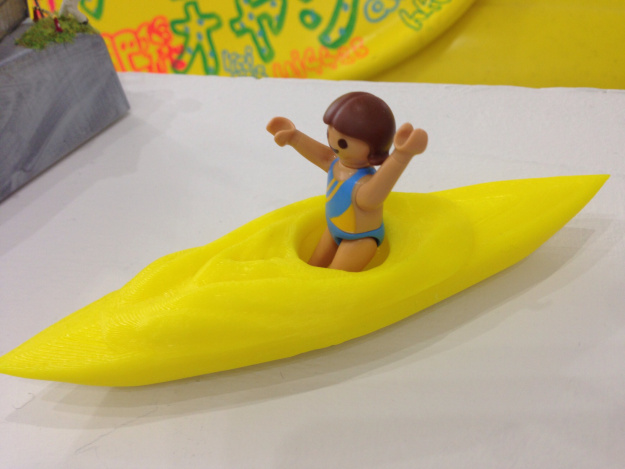
The files in question are, to be clear, fairly stylized representations of the female form, as is most of her art. Igarashi, who calls herself Rokudenashi-ko or “Good-For-Nothing Girl,” began making the prints when she decided to explore her own sexuality and the role of the female form in Japanese culture. While the male member is not as taboo in Japanese culture (NSFW example), the female genitals are all but hidden.
“As an artist, I focus on my own vagina as the motif for my art,” she wrote. “My work is against discriminative / ignorant treatment of the vagina.”
“I cannot understand why the police recognize the 3D data as obscene material,” she said.
Her fundraising goal was to raise money to build something called the Manko-boat or Manbo, essentially “pussy boat,” based on the shape of her vagina. Her charmingly innocuous pitch video appears below.
The question this arrest raises, obviously, is what can be defined as obscenity, especially in regard to self-scanning, 3D printing, and art. No rational person would mistake Igarashi’s work with pornography but, clearly, she is not dealing with rational people. In the end, control over her body and her image is solely hers and, I suspect, art will win out.
Brilliant VFX whip up a storm
A seamless combination of video and 3D animation sees a young boy encounter a sea storm in this thrilling new ad. We find out how it was made.
http://youtu.be/qXUnqQ-Er-M
Insurance company Delta Lloyd recently commissioned advertising agency TBWA\NEBOKO to create this new spot, which features the voyage of a young boy, who negotiates the elements of the ocean on a small boat.
Along his journey, he encounters seals, a storm, vortex and huge whale, all of which were created by French post production house Digital District. " 'Storm in the open sea' were the first words we heard about the film," says FX supervisor Thomas Marqué.
Naiad also provided the solution to the team's biggest challenge. "The sea surface becomes more complex in a storm, a little swash turn into a very detailed mountain full of foam and sea sprays," says FX lead Marc Thomas Cavé.

Fluid simulation software Naiad provided the Digital District team with the solution to all their sea simualtion issues
"For the surface itself, we used a NOT-ocean mesh in Naiad to create the main surface. This object is very sharp and detailed and acted as our base to work on foam, splashes, sprays and wakes. It's also the reference surface for the animator in charge of the boats. Naiad is powerful enough to make particles collide on such detailed meshes - it was a vital piece of software on this project."
http://youtu.be/qXUnqQ-Er-M
Insurance company Delta Lloyd recently commissioned advertising agency TBWA\NEBOKO to create this new spot, which features the voyage of a young boy, who negotiates the elements of the ocean on a small boat.
Along his journey, he encounters seals, a storm, vortex and huge whale, all of which were created by French post production house Digital District. " 'Storm in the open sea' were the first words we heard about the film," says FX supervisor Thomas Marqué.
The goal was simple - make it real
Naiad also provided the solution to the team's biggest challenge. "The sea surface becomes more complex in a storm, a little swash turn into a very detailed mountain full of foam and sea sprays," says FX lead Marc Thomas Cavé.
Fluid simulation software Naiad provided the Digital District team with the solution to all their sea simualtion issues
"For the surface itself, we used a NOT-ocean mesh in Naiad to create the main surface. This object is very sharp and detailed and acted as our base to work on foam, splashes, sprays and wakes. It's also the reference surface for the animator in charge of the boats. Naiad is powerful enough to make particles collide on such detailed meshes - it was a vital piece of software on this project."


Monday, July 7, 2014


Sunday, July 6, 2014




Sunday, June 29, 2014


Saturday, June 28, 2014
Thursday, June 19, 2014
ANIMATORS IN ACTION The Hobbit: The Desolation of Smaug
Hollywod production, Hobbit The Desolation of Smaug how they make
attention for mocap suite
Friday, June 13, 2014
Sunday, June 8, 2014
Thursday, May 29, 2014
Monday, May 26, 2014
Sunday, May 25, 2014
Saturday, May 24, 2014
Friday, May 16, 2014
Thursday, May 15, 2014
Wednesday, May 14, 2014
Tuesday, May 13, 2014


Monday, May 12, 2014
Saturday, May 10, 2014

Wednesday, May 7, 2014
Tuesday, May 6, 2014
Monday, May 5, 2014
LOD continued
Although the algorithm introduced above covers a whole range of level of detail management techniques, real world applications usually employ different methods according the information being rendered. Because of the appearance of the considered objects, two main algorithm families are used.[3]
The first is based on subdividing the space in a finite number of regions, each with a certain level of detail. The result is discrete number of detail levels, from which the name Discrete LoD (DLOD). There's no way to support a smooth transition between LOD levels at this level, although alpha blending or morphing can be used to avoid visual popping.
The second considers the polygon mesh being rendered as a function which must be evaluated requiring to avoid excessive errors which are a function of some heuristic (usually distance) themselves. The given "mesh" function is then continuously evaluated and an optimized version is produced according to a tradeoff between visual quality and performance. These types of algorithms are usually referred as Continuous LOD (CLOD).
Details on Discrete LOD
An example of various DLOD ranges. Darker areas are meant to be rendered with higher detail. An additional culling operation is run, discarding all the information outside the frustum (colored areas).
The basic concept of discrete LOD (DLOD) is to provide various models to represent the same object. Obtaining those models requires an external algorithm which is often non-trivial and subject of many polygon reduction techniques. Successive LOD-ing algorithms will simply assume those models are available.
DLOD algorithms are often used in performance-intensive applications with small data sets which can easily fit in memory. Although out-of-core algorithms could be used, the information granularity is not well suited to this kind of application. This kind of algorithm is usually easier to get working, providing both faster performance and lower CPU usage because of the few operations involved.
DLOD methods are often used for "stand-alone" moving objects, possibly including complex animation methods. A different approach is used for geomipmapping[4], a popular terrain rendering algorithm because this applies to terrain meshes which are both graphically and topologically different from "object" meshes. Instead of computing an error and simplify the mesh according to this, geomipmapping takes a fixed reduction method, evaluates the error introduced and computes a distance at which the error is acceptable. Although straightforward, the algorithm provides decent performance.
A discrete LOD example
As a simple example, consider the following sphere. A discrete LOD approach would cache a certain number of models to be used at different distances. Because the model can trivially be procedurally generated by its mathematical formulation, using a different amount of sample points distributed on the surface is sufficient to generate the various models required. This pass is not a LOD-ing algorithm.
Visual impact comparisons and measurements
Image
Vertices ~5500 ~2880 ~1580 ~670 140
Notes Maximum detail,
for closeups. Minimum detail,
very far objects.
To simulate a realistic transform bound scenario, we'll use an ad-hoc written application. We'll make sure we're not CPU bound by using simple algorithms and minimum fragment operations. Each frame, the program will compute each sphere's distance and choose a model from a pool according to this information. To easily show the concept, the distance at which each model is used is hard coded in the source. A more involved method would compute adequate models according to the usage distance chosen.
We use OpenGL for rendering because its high efficiency in managing small batches, storing each model in a display list thus avoiding communication overheads. Additional vertex load is given by applying two directional light sources ideally located infinitely far away.
The following table compares the performance of LoD aware rendering and a full detail (brute force) method.
Visual impact comparisons and measurements
Brute DLOD Comparison
Rendered
images
Render time 27.27 ms 1.29 ms 21 × reduction
Scene vertices
(thousands) 2328.48 109.44 21 × reduction
Hierarchical LOD
Because hardware is geared towards large amounts of detail, rendering low polygon objects may score sub-optimal performances. HLOD avoids the problem by grouping different objects together[5]. This allows for higher efficiency as well as taking advantage of proximity considerations.
Level of Detail LOD
In computer graphics, accounting for level of detail involves decreasing the complexity of a 3D object representation as it moves away from the viewer or according to other metrics such as object importance, viewpoint-relative speed or position. Level of detail techniques increases the efficiency of rendering by decreasing the workload on graphics pipeline stages, usually vertex transformations. The reduced visual quality of the model is often unnoticed because of the small effect on object appearance when distant or moving fast.
Although most of the time LOD is applied to geometry detail only, the basic concept can be generalized. Recently, LOD techniques also included shader management to keep control of pixel complexity. A form of level of detail management has been applied to textures for years, under the name of mipmapping, also providing higher rendering quality.
It is commonplace to say that "an object has been LOD'd" when the object is simplified by the underlying LOD-ing algorithm.
Sunday, May 4, 2014
Saturday, May 3, 2014
Friday, May 2, 2014
Thursday, April 24, 2014
Tuesday, April 22, 2014
Sunday, April 20, 2014
The Fly Vfx Breakdown by Giulio Tonini
These are five shots I recently worked on. Even house flies drop dead because of boring and bad quality programmes on TV!
I used Maya for the animation, shading and rendering with Arnold Render and Nuke for compositing.
rendering with Arnold Render and Nuke for compositing.


Saturday, April 12, 2014
Hybrids Realflow
Reference to demon wave characteristic
https://www.youtube.com/watch?v=XPrs0H0Adig&feature=youtube_gdata_player
https://www.youtube.com/watch?v=XPrs0H0Adig&feature=youtube_gdata_player
Tuesday, March 11, 2014

Sunday, February 16, 2014
Thursday, November 14, 2013
Flight Kit and Jet Strike Video Copilot

Setelah sekian lama menunggu 2 benda ni akhirnya masuk jugak ke PC aku.9.87 GB yang speed ciput average 14 kb/s bayangkan bila mau siap, itulah yang dikatakan kesabaran mengatasi segalanya.
So what now! explore dulu cuba dalam 3dmax, esok nak pi vacation after baru install dalam AE and start rockin....stay tuned
Wednesday, November 6, 2013
Tank- AMX 30


AMX 30
Physical spec:
Place of origin: France
Weight: 36 tons
Width: 3.1m
Height: 2.28m
Crew:4 (commander, gunner , loader, driver)
Armor: 80 mm (3.1 in) maximum[1]
Main armament:105 mm Modèle F1 tank gun
Secondary armament:20 mm autocannon, 7.62 mm machine gun machine gun
Engine: Hispano-Suiza HS-110 680 hp (510 kW)-720 hp (540 kW)
Transmission:Manual on AMX30; Semi-automatic SESM ENC200 on AMX-30B2
Suspension torsion bar Operational range: 600 km (370 mi)
Speed:65 km/h (40 mph
Source: Wikipedia
Tuesday, November 5, 2013

Friday, October 25, 2013
Format pc
Asalnya nak tambah ram tapi bila slot ram baru signal pula takada, atas nasihat google update bios baru, nak jadi cerita mungkin bios yang dipilih telah silap, keluar mesej "bootmgr missing".2-3kali reboot macam tu jugak. Panik juga tak pernah alami situasi macamni sebab minggu depan dateline nak hantar report kat boss pula. Last choice terpaksa kena format itu pun tak tahu ok ke tak. Kalau tak ok terpaksa hantar kedai...
Monday, October 21, 2013

Saturday, October 19, 2013
Configure Real Flow pluggin dalam 3d Max 2013
Setelah bertungkus-lumus, cari dalam google, pergi kat Next Limit help desk akhirnya dapat juga fail nak configure ke 3d Max 2013

Lepas ni bolehlah start play around
Install Real Flow 2012

Sudah selesai install
Realflow 2012 dri Next Limit. Baru nak belajar explore benda ni. Lain kali bolehlah buat CGI. Producer2 yang nak hired boleh lah....
Privatise blog
Bermula hari ini blog ini akan akan dihadkan kepada admin saja. Langkah ini dibuat memandangkan buat masa ini kandungan dalam blog ini tidak sepenuhnya milik peribadi admin. Blog ini akan dibuka kepada public segali gus disenaraikan dalam carian google setelah kandungan, artikel, hasil karya sepenuh nya milik admin. Admin akan mengemaskini entry yang mengandungi hasil yang mempunyai copyright dan akan memberikan sumber darimana ia diperolehi
Friday, October 18, 2013

Install Plugin 3d Max
3d Max 2013 64 bit dah install, sekarang nak configure plugin pula
Fume FX


Fume FX
VRay

Lepas siap ni baru boleh rockin....
Thursday, October 17, 2013

Wednesday, October 16, 2013

Monday, July 1, 2013
Sunday, April 7, 2013
Thursday, April 4, 2013
Russian Knights at Langkawi International Maritime & Aerospace (LIMA) 20...
LIMA 2013 29-30th March 2013
Friday, February 1, 2013

Saturday, January 26, 2013

Wednesday, January 23, 2013

Harrier in action

Saturday, January 19, 2013
Experiment elementary 3d element video copilot AE

Published with Blogger-droid v1.6.7
Wednesday, January 9, 2013

Thursday, January 3, 2013


Sunday, December 30, 2012

Tuesday, December 25, 2012

Monday, December 24, 2012

Sunday, December 23, 2012
Shuriken

Shuriken, test
Shurken guna software adobe after effect + pluggin dari video copilot 3d element. Sungguh cool
Monday, December 10, 2012

Sunday, December 9, 2012
Windows 7 64 bit
Install pakai cd copy dari torrent. Kemudian install 3dmax 2010+pluggin require 64 bit.... still inprogress
Subscribe to:
Posts (Atom)